Coimbra, a city in central Portugal, has one of the most beautiful - and creepy - love stories ever to be heard. It is the story of Pedro and Inês, a Portuguese heir to the throne and a Spanish aristocrat's maid. It has a tragic ending, much more gruesome than Romeo and Juliet (Pedro's own father, king Afonso IV, fears a political scandal and has Inês assissined), and contains what is one of the most extraordinary episodes in royal history: Pedro, besides declaring war on his father, declares he had wed his lover in secret shortly before her death, has her body exhumed and placed on a throne, and has the entire court kiss the dead girl's hand as a sign of loyalty to their sovereign. Inês spent her last years in a Monastery in Coimbra, and the city is to this day associated with romance. Now, what is particularly enjoyable in the story you are about to read, is that it happened in the same town, and yet, none of it ever meant to deal with the legend. It is but a simple story of two people. One of them happens to be the architect and artist Juan de la Mora.
"These hearts were painted by my girlfriend and I in Coimbra, Portugal a couple of years back. She is from Coimbra and I am from Chicago and we've been able to maintain a long distance relationship for the past 2.5 years. Since then, we continue to paint some of these hearts every time we are together in Coimbra. What is interesting about Portugal's Calçada (sidewalk), is that you can take a combination of a minimum of three stones and find the shape of an abstract heart form. The heart can grow by adding more stones to the original three." Source URL: https://tattoosnyong.blogspot.com/search/label/Portugal Visit tattoos nyong for Daily Updated Hairstyles Collection
Coimbra, a city in central Portugal, has one of the most beautiful - and creepy - love stories ever to be heard. It is the story of Pedro and Inês, a Portuguese heir to the throne and a Spanish aristocrat's maid. It has a tragic ending, much more gruesome than Romeo and Juliet (Pedro's own father, king Afonso IV, fears a political scandal and has Inês assissined), and contains what is one of the most extraordinary episodes in royal history: Pedro, besides declaring war on his father, declares he had wed his lover in secret shortly before her death, has her body exhumed and placed on a throne, and has the entire court kiss the dead girl's hand as a sign of loyalty to their sovereign. Inês spent her last years in a Monastery in Coimbra, and the city is to this day associated with romance. Now, what is particularly enjoyable in the story you are about to read, is that it happened in the same town, and yet, none of it ever meant to deal with the legend. It is but a simple story of two people. One of them happens to be the architect and artist Juan de la Mora.
"These hearts were painted by my girlfriend and I in Coimbra, Portugal a couple of years back. She is from Coimbra and I am from Chicago and we've been able to maintain a long distance relationship for the past 2.5 years. Since then, we continue to paint some of these hearts every time we are together in Coimbra. What is interesting about Portugal's Calçada (sidewalk), is that you can take a combination of a minimum of three stones and find the shape of an abstract heart form. The heart can grow by adding more stones to the original three." Source URL: https://tattoosnyong.blogspot.com/search/label/Portugal Visit tattoos nyong for Daily Updated Hairstyles Collection
In a comment in the Portuguese daily newspaper Público, my colleague Tiago Bartolomeu Costa commented on a controversial artistic residency at the Gulbenkian Foundation, which ended in October with a presentation of the works. A number of young visual and performance artists were invited for a 2-month residency in the very space where the Foundation’s collection of contemporary Portuguese art is usually presented. The place was completely transformed into 30 large cubicles or divisions. Visitors to the museum could eavesdrop and discover how each artist develops his work, as the space opened for the general public during several hours in the afternoon. Theoretically, one could accompany the entire process day-by-day (I wonder if anyone tried). The entire (impressive and extensive) program which incorporated this daring initiative is called The State of the World, and this very title makes me feel somewhat uneasy. But first, let's hear Tiago:
Generally speaking, the protagonists of the arts of the body that were present [during the day of presentation] seem to have wasted an opportunity to reflect about what it means to create today. (...) the propositions (...) had in common what the artist Christian Boltanski called "the small memory" (...), but which to many of the creators became a runaway solution [in Portuguese: escape]: an apology of the idea that a selection of immediate and generational references can substitute, without any loss, History's evolutive processes.
There are several very important statements implied in this short fragment. 1) That there is a History. And not many histories, stories, lines. Indeed, in this perspective it is clear that the artists Tiago speaks of missed the point completely. However, "History" remains to be proven. And although History's end has been suspended, this still does not mean we have but the choice of either facing it or questioning it. But the very fact that the word appears here, in all its capital-letter majesty, is not benign. It has to do with the very opinion that artists should work on something called "The State of the World". What World? What State? What are we to do of the the legacy of the last 40 years of thought (and Boltanski is in the midst of it), with its “shift from history to discourse, from a third- to a second-person address” (Craig Owen, quoted from a famous essay called The Allegorical Impulse: Toward a Theory of Postmodernism )? 2) That there is an evolution, and that it can be ceased. This does make sense if we see any change as evolution. And makes a very interesting point: how do we feel evolution today? Beyond terrorism and cell phones, how does our (my) world pulsate? What leaks? What swallows? What itches? What feels good? I quite agree with Tiago that there is a tension that remains to be read, deciphered, discovered. However, 3) Shouldn't we accept this sort of intimate storytelling as an acceptance of one's own limits, an artistic modesty that is praiseworthy? It might go further than the postmodernist paradigm described through Craig Owens’ words. There is a telling slip of the tongue in the comment. If we read it literally, it suggests that the "selection of references" cannot "substitute History". This, however, implies that the artists put the generational references as an ontological substitute for History's processes. Which they don't (nobody declares or implies that the processes are susbsitututed). The problem might be precisely this: in the case of some of the young performers, the artistic discourse doesn't seem to come near the question of histories vs. History. The modesty seems almost unconscious, more like a limitation than a choice or perspective. So Tiago does raise an important issue: how can art deal with the world and its new type of globality? We are more conscious today of what the world is than ever before. Might that be why we are more reluctant to generalize, or even try and define its processes? But can we just turn away and ignore them? Of course we can. So why would we participate in an event called State of the World? On one hand, this "small talk" of the "small memory" could be saying a lot about the State of the World, seen from here and now. On the other, its difficulty with approaching these Capital-Lettered-Concepts could be a hint that maybe its time to start off without the caps.
Here is a poem by Wislawa Szymborska, the Polish Nobel-Prize-Winner:
No Title Required
It has come to this: I’m sitting under a tree beside a river on a sunny morning. It’s an insignificant event and won’t go down in history. It’s not battles and pacts, where motives are scrutinized, or noteworthy tyrannicides.
And yet I’m sitting by this river, that’s a fact. And since I’m here I must have come from somewhere, and before that I must have turned up in many other places, exactly like the conquerors of nations before setting sail.
Even a passing moment has its fertile past, its Friday before Saturday, its May before June. Its horizons are no less real than those that a marshal’s field glasses might scan.
This tree is a poplar that’s been rooted here for years. The river is the Raba; it didn’t spring up yesterday. The path leading through the bushes wasn’t beaten last week. The wind had to blow the clouds here before it could blow them away.
And though nothing much is going on nearby, the world is no poorer in details for that. It’s just as grounded, just as definite as when migrating races held it captive.
Conspiracies aren’t the only things shrouded in silence. Retinues of reasons don’t trail coronations alone. Anniversaries of revolutions may roll around, but so do oval pebbles encircling the bay.
The tapestry of circumstance is intricate and dense. Ants stitching in the grass. The grass sewn into the ground. The pattern of a wave being needled by a twig.
So it happens that I am and look. Above me a white butterfly is fluttering through the air on wings that are its alone, and a shadow skims through my hands that is none other than itself, no one else’s but its own.
When I see such things, I’m no longer sure that what’s important is more important than what’s not.
I know, Tiago - the big question remains: is this, can this small memory be enough? Can we spend time watching little branches and the butterflies' wings, and claim to any sort of authority in regards to the State of the World, or the states of the worlds, for that matter? It's a beautiful poem. One of the things I like most about it, though, is that Szymborska is not sure. There is a hesitation here. While us, poor contemporary creative bastards, often take it for granted. We just move on, as if this was it.
How many capital letters can we keep? How many should we? Is it a question of the times that are a-changin? The closest I ever came to a war was when the tanks appeared on the streets in Poland in 1981. I was 3. My memory of it is fairly clear. But do I need to have this memory to have my sense of what is important? Can’t we define the world as superficially as we feel allowed to? But shouldn’t a good artist be able to overcome the obstacle of taking all the caps off, and find a capital letter after all, say in the “l” that looks so much like a “1”? But then again, should she? Or is she better off in the small narratives? Does the “I” only stand for “1”?
= =
NB: Notice that Tiago is a performing arts critic. Would he write something of the sort if he were a fine arts critic? It seems unlikely. The modernist paradigm of an artistic soul that needs not the sullied, exterior world to create, is still quite omnipresent in the fine arts. The performing arts, particularly theater, have quite a different point of view, with a tendency to see the work through the prism of its engagement with the public, its dialog with “society”. I feel more affinity with the latter position. But doesn’t it sometimes limit our appreciation of the generous universe of art?
In a comment in the Portuguese daily newspaper Público, my colleague Tiago Bartolomeu Costa commented on a controversial artistic residency at the Gulbenkian Foundation, which ended in October with a presentation of the works. A number of young visual and performance artists were invited for a 2-month residency in the very space where the Foundation’s collection of contemporary Portuguese art is usually presented. The place was completely transformed into 30 large cubicles or divisions. Visitors to the museum could eavesdrop and discover how each artist develops his work, as the space opened for the general public during several hours in the afternoon. Theoretically, one could accompany the entire process day-by-day (I wonder if anyone tried). The entire (impressive and extensive) program which incorporated this daring initiative is called The State of the World, and this very title makes me feel somewhat uneasy. But first, let's hear Tiago:
Generally speaking, the protagonists of the arts of the body that were present [during the day of presentation] seem to have wasted an opportunity to reflect about what it means to create today. (...) the propositions (...) had in common what the artist Christian Boltanski called "the small memory" (...), but which to many of the creators became a runaway solution [in Portuguese: escape]: an apology of the idea that a selection of immediate and generational references can substitute, without any loss, History's evolutive processes.
There are several very important statements implied in this short fragment. 1) That there is a History. And not many histories, stories, lines. Indeed, in this perspective it is clear that the artists Tiago speaks of missed the point completely. However, "History" remains to be proven. And although History's end has been suspended, this still does not mean we have but the choice of either facing it or questioning it. But the very fact that the word appears here, in all its capital-letter majesty, is not benign. It has to do with the very opinion that artists should work on something called "The State of the World". What World? What State? What are we to do of the the legacy of the last 40 years of thought (and Boltanski is in the midst of it), with its “shift from history to discourse, from a third- to a second-person address” (Craig Owen, quoted from a famous essay called The Allegorical Impulse: Toward a Theory of Postmodernism )? 2) That there is an evolution, and that it can be ceased. This does make sense if we see any change as evolution. And makes a very interesting point: how do we feel evolution today? Beyond terrorism and cell phones, how does our (my) world pulsate? What leaks? What swallows? What itches? What feels good? I quite agree with Tiago that there is a tension that remains to be read, deciphered, discovered. However, 3) Shouldn't we accept this sort of intimate storytelling as an acceptance of one's own limits, an artistic modesty that is praiseworthy? It might go further than the postmodernist paradigm described through Craig Owens’ words. There is a telling slip of the tongue in the comment. If we read it literally, it suggests that the "selection of references" cannot "substitute History". This, however, implies that the artists put the generational references as an ontological substitute for History's processes. Which they don't (nobody declares or implies that the processes are susbsitututed). The problem might be precisely this: in the case of some of the young performers, the artistic discourse doesn't seem to come near the question of histories vs. History. The modesty seems almost unconscious, more like a limitation than a choice or perspective. So Tiago does raise an important issue: how can art deal with the world and its new type of globality? We are more conscious today of what the world is than ever before. Might that be why we are more reluctant to generalize, or even try and define its processes? But can we just turn away and ignore them? Of course we can. So why would we participate in an event called State of the World? On one hand, this "small talk" of the "small memory" could be saying a lot about the State of the World, seen from here and now. On the other, its difficulty with approaching these Capital-Lettered-Concepts could be a hint that maybe its time to start off without the caps.
Here is a poem by Wislawa Szymborska, the Polish Nobel-Prize-Winner:
No Title Required
It has come to this: I’m sitting under a tree beside a river on a sunny morning. It’s an insignificant event and won’t go down in history. It’s not battles and pacts, where motives are scrutinized, or noteworthy tyrannicides.
And yet I’m sitting by this river, that’s a fact. And since I’m here I must have come from somewhere, and before that I must have turned up in many other places, exactly like the conquerors of nations before setting sail.
Even a passing moment has its fertile past, its Friday before Saturday, its May before June. Its horizons are no less real than those that a marshal’s field glasses might scan.
This tree is a poplar that’s been rooted here for years. The river is the Raba; it didn’t spring up yesterday. The path leading through the bushes wasn’t beaten last week. The wind had to blow the clouds here before it could blow them away.
And though nothing much is going on nearby, the world is no poorer in details for that. It’s just as grounded, just as definite as when migrating races held it captive.
Conspiracies aren’t the only things shrouded in silence. Retinues of reasons don’t trail coronations alone. Anniversaries of revolutions may roll around, but so do oval pebbles encircling the bay.
The tapestry of circumstance is intricate and dense. Ants stitching in the grass. The grass sewn into the ground. The pattern of a wave being needled by a twig.
So it happens that I am and look. Above me a white butterfly is fluttering through the air on wings that are its alone, and a shadow skims through my hands that is none other than itself, no one else’s but its own.
When I see such things, I’m no longer sure that what’s important is more important than what’s not.
I know, Tiago - the big question remains: is this, can this small memory be enough? Can we spend time watching little branches and the butterflies' wings, and claim to any sort of authority in regards to the State of the World, or the states of the worlds, for that matter? It's a beautiful poem. One of the things I like most about it, though, is that Szymborska is not sure. There is a hesitation here. While us, poor contemporary creative bastards, often take it for granted. We just move on, as if this was it.
How many capital letters can we keep? How many should we? Is it a question of the times that are a-changin? The closest I ever came to a war was when the tanks appeared on the streets in Poland in 1981. I was 3. My memory of it is fairly clear. But do I need to have this memory to have my sense of what is important? Can’t we define the world as superficially as we feel allowed to? But shouldn’t a good artist be able to overcome the obstacle of taking all the caps off, and find a capital letter after all, say in the “l” that looks so much like a “1”? But then again, should she? Or is she better off in the small narratives? Does the “I” only stand for “1”?
= =
NB: Notice that Tiago is a performing arts critic. Would he write something of the sort if he were a fine arts critic? It seems unlikely. The modernist paradigm of an artistic soul that needs not the sullied, exterior world to create, is still quite omnipresent in the fine arts. The performing arts, particularly theater, have quite a different point of view, with a tendency to see the work through the prism of its engagement with the public, its dialog with “society”. I feel more affinity with the latter position. But doesn’t it sometimes limit our appreciation of the generous universe of art?
1. Time-based art has one crucial characteristic: it is time-based. Bare with me. Whether it's Matthew Barney's latest motion picture or a Dan Graham's classic tableau of the spectator, in this universe, the appearance of something is defined by its appearing. Well, as obvious as it might seem, this idea is often forgotten and disrespected by both artists and curators... A visit to the Museu do Chiado, where a temporary exhibition of the classics of Centro Pompidou is shown until January, makes it pretty clear. But what makes appearing a problem?
2. First, let’s clear some semantic issues. What is this thing that is sometimes called “video art”, at other times, “video installation”? For one, let’s distinguish "sculptural installations that include video" (and call them video installations) from "films shown as a work of visual art, either on a TV screen or a projection or the like" (and call themsimply video art). Also, video art can be closed-circuit (with a live - or near-live - image from a camera) or pre-recorded: this last case is basically a film, whether it’s abstract spots, the film of a tree growing or a narrative fiction (and whether it's single- or multi-channel). It’s the film I’m interested here in.
3. When entering a room with video art, I have a much better chance of appearing at the middle of the film than at the beginning. But is there a beginning? And does it matter? After all, in most cases of showing a finished, pre-recorded video, and not a closed-circuit video where we are seeing live or nearly-live footage, the artist himself suggested or accepted the idea that his work would be shown in a loop. What does it matter that a time-based work starts anywhere? A valid argument is that this approach can have substantial causes. The starting point can be irrelevant or of little importance (e.g., in the footage of Gordon Matta-Clark's Day's End), or in Douglas Gordon's Foot and Hand:
It can also be an essential element of the work. After all, the loop might just be the closest we can get to eternity. Yet this is not always the case. Not in regards to the works I've seen at the Museu do Chiado. Most of them not only acknowledge the existence of a chronological dynamic, but clearly use it in their very structure. (The curious thing here is that many of the works at the Museu do Chiado focus on the concept of time. There is talk of empty spaces in time, of the slowing down of time, of the feel of time. And yet, the point (of time) when the spectator enters seems to matter little!) It shouldn’t be surprising that film may well have a dramaturgy that develops over time! We may need to see the work from the beginning to the end to feel it. The only problem is - by the time we've seen it all, we've probably seen the end already and it just doesn't feel the same - sort of like having seen a spoiler in a trailer. You can still enjoy the feature film afterwards, but you wish you didn't know so much. The other argument is a pragmatic one: how are we to show a film from beginning to end to every single visitor? It seems impossible. But only at first glance. If you look carefully, you see how technology has changed - and the audience, too. Today, we are out of the videotape era, and we can easily go beyond the loop. We can have a PLAY button on every TV set that shows a work, we can have DVD menus, and even (cheap!) infrared sensors that play the video when a new visitor enters. And if anyone is worried about the overflow of spectators who make it impossible to keep starting at the beginning - unless you are at the Pompidou or at some other big-shot museum, it really isn't a problem. The museums and galleries still have a tendency to remain empty, there is more than enough time, and if there isn't, hardly anyone will mind waiting a minute longer to see the next work. It will only make her stop a few minutes longer by the previous one. Which wouldn’t be that worrying, now, would it?
4. Another issue comes to mind: What sort of aesthetic experience do we have while loopvision is still the spectators default universe? How do I, as a spectator, deal with seeing something “as if” I didn’t know the end/goal/development? It is not quite as if watching something I’ve seen (in its entirety) before. Could I say I am experiencing something, but acting as if I weren’t experiencing it just yet, fooling myself into a “genuine” experience? But is it not an ever more distant one, a bracketed one? The brackets... of knowledge? The issue of a well-informed spectator. A too-well-informed spectator. Let’s not over-simplify it into the old discussion of an intelligent reading of a work vs. an emotional living of it. There is more to our experience of a work of art, and it seems a fertile ground for further discussion. There is a sense of an incredibly fertile ground in the multiple and complex layers of what is and could be lived through by the spectator. The on-looker. The in-looker.
PS: Here is a video I would love to see looped and looped and looped- Gilbert and George's Ten Commandments For Gilbert and George. Notice the modesty in the title. The commandments are for them. They do not feel any need to preach them to the world, beyond proclaiming that this is what they choose for themselves. Source URL: https://tattoosnyong.blogspot.com/search/label/Portugal Visit tattoos nyong for Daily Updated Hairstyles Collection
1. Time-based art has one crucial characteristic: it is time-based. Bare with me. Whether it's Matthew Barney's latest motion picture or a Dan Graham's classic tableau of the spectator, in this universe, the appearance of something is defined by its appearing. Well, as obvious as it might seem, this idea is often forgotten and disrespected by both artists and curators... A visit to the Museu do Chiado, where a temporary exhibition of the classics of Centro Pompidou is shown until January, makes it pretty clear. But what makes appearing a problem?
2. First, let’s clear some semantic issues. What is this thing that is sometimes called “video art”, at other times, “video installation”? For one, let’s distinguish "sculptural installations that include video" (and call them video installations) from "films shown as a work of visual art, either on a TV screen or a projection or the like" (and call themsimply video art). Also, video art can be closed-circuit (with a live - or near-live - image from a camera) or pre-recorded: this last case is basically a film, whether it’s abstract spots, the film of a tree growing or a narrative fiction (and whether it's single- or multi-channel). It’s the film I’m interested here in.
3. When entering a room with video art, I have a much better chance of appearing at the middle of the film than at the beginning. But is there a beginning? And does it matter? After all, in most cases of showing a finished, pre-recorded video, and not a closed-circuit video where we are seeing live or nearly-live footage, the artist himself suggested or accepted the idea that his work would be shown in a loop. What does it matter that a time-based work starts anywhere? A valid argument is that this approach can have substantial causes. The starting point can be irrelevant or of little importance (e.g., in the footage of Gordon Matta-Clark's Day's End), or in Douglas Gordon's Foot and Hand:
It can also be an essential element of the work. After all, the loop might just be the closest we can get to eternity. Yet this is not always the case. Not in regards to the works I've seen at the Museu do Chiado. Most of them not only acknowledge the existence of a chronological dynamic, but clearly use it in their very structure. (The curious thing here is that many of the works at the Museu do Chiado focus on the concept of time. There is talk of empty spaces in time, of the slowing down of time, of the feel of time. And yet, the point (of time) when the spectator enters seems to matter little!) It shouldn’t be surprising that film may well have a dramaturgy that develops over time! We may need to see the work from the beginning to the end to feel it. The only problem is - by the time we've seen it all, we've probably seen the end already and it just doesn't feel the same - sort of like having seen a spoiler in a trailer. You can still enjoy the feature film afterwards, but you wish you didn't know so much. The other argument is a pragmatic one: how are we to show a film from beginning to end to every single visitor? It seems impossible. But only at first glance. If you look carefully, you see how technology has changed - and the audience, too. Today, we are out of the videotape era, and we can easily go beyond the loop. We can have a PLAY button on every TV set that shows a work, we can have DVD menus, and even (cheap!) infrared sensors that play the video when a new visitor enters. And if anyone is worried about the overflow of spectators who make it impossible to keep starting at the beginning - unless you are at the Pompidou or at some other big-shot museum, it really isn't a problem. The museums and galleries still have a tendency to remain empty, there is more than enough time, and if there isn't, hardly anyone will mind waiting a minute longer to see the next work. It will only make her stop a few minutes longer by the previous one. Which wouldn’t be that worrying, now, would it?
4. Another issue comes to mind: What sort of aesthetic experience do we have while loopvision is still the spectators default universe? How do I, as a spectator, deal with seeing something “as if” I didn’t know the end/goal/development? It is not quite as if watching something I’ve seen (in its entirety) before. Could I say I am experiencing something, but acting as if I weren’t experiencing it just yet, fooling myself into a “genuine” experience? But is it not an ever more distant one, a bracketed one? The brackets... of knowledge? The issue of a well-informed spectator. A too-well-informed spectator. Let’s not over-simplify it into the old discussion of an intelligent reading of a work vs. an emotional living of it. There is more to our experience of a work of art, and it seems a fertile ground for further discussion. There is a sense of an incredibly fertile ground in the multiple and complex layers of what is and could be lived through by the spectator. The on-looker. The in-looker.
PS: Here is a video I would love to see looped and looped and looped- Gilbert and George's Ten Commandments For Gilbert and George. Notice the modesty in the title. The commandments are for them. They do not feel any need to preach them to the world, beyond proclaiming that this is what they choose for themselves. Source URL: https://tattoosnyong.blogspot.com/search/label/Portugal Visit tattoos nyong for Daily Updated Hairstyles Collection
I am now going back to rehearsals of Hamlet Light, which will have its premiere on September 15th at the Teatro Municipal de Faro and will be in Lisbon on September 28-30. In order to enjoy theatre, shouldn’t we forget it? Forget that we’re inside a theatre, forget how it works? How about if we just forgot the whole idea of a production and simply focused on how to advertise it? If instead of the play the audience saw the creation of a play’s trailer? What would remain? What would the new scale of possibilities be?
More on this later. (My activity here might slow down a bit. Or not.)
I am now going back to rehearsals of Hamlet Light, which will have its premiere on September 15th at the Teatro Municipal de Faro and will be in Lisbon on September 28-30. In order to enjoy theatre, shouldn’t we forget it? Forget that we’re inside a theatre, forget how it works? How about if we just forgot the whole idea of a production and simply focused on how to advertise it? If instead of the play the audience saw the creation of a play’s trailer? What would remain? What would the new scale of possibilities be?
More on this later. (My activity here might slow down a bit. Or not.)
1. The performance does not concern the disappearance of light. Rather, it is about the disappearance of shadow. The shadow of causality, of logic, of story-ness, the shadow of the human realm as we know it. Here, what we have are states. Functions. The performers don't act, they remain in action. The very first scene, where the musician walks along all the walls of the stage scratching them with a small microphone, says it all: this is going to take time, and you better deal with it. If you're not happy with it, you might just as well leave now. I will remain as long as it takes. And when it's over, it's simply gone. This doesn't need to lead anywhere but here, to the sound table. It doesn't need to tell a story other than my trip from there to here. Unsatisfied? Yes, I can understand. But can't you just appreciate it, for what it is - somebody's notion of honesty?
2. What is your function? Are you being the person that listens? Or the one that speaks? Are you the guy that draws lines? Are you the dancer girl? And what does that mean? Do you fit in when you do your thing? Do you ever not fit in? What comes out of your standing here?
3. The dancer girl - Márcia - never actually dances. She sort of warms up, tries a jump or two, prepares her body. She gets comfortable. And leaves. While she does that, a snail race is being prepared. During the general rehearsal, when Lenaic put the snails, she didn't align them to make them advance in the same direction, and they just dispersed all over. I asked her after if it was on purpose. She said no, and at the premiere they are quite carefully aligned. And I miss the havoc. I regret having asked the question.
4. The risk is huge. About half of the show is improvised. The structure remains, but the way of filling in, of respecting the tough rules of Real-Time Composition, is up to the performers, and depends on every show. It can always go wrong. It would really make more sense to see two show in a row, every time.
5. The general rehearsal goes very bad. They are aggressive, tired, unimaginative. They choose either the simplest and flat solutions, or they jump off into something completely nonsensical and unrelated. Things seem chaotic. The show ends with a quote from Deleuze, about how happiness/joy empowers. It sounds ironic.
6. The premiere goes incredibly well. Everything is right. The improvised parts all come together. The performers are strong, at first still somewhat too heavy and inexplicably over-present (too dramatic, too «significant», as if they were constantly in the middle of to be or not to be), but the performance quickly gains a good pace.
7. At a certain point, Lenaic leaves the stage with a microphone, and we hear her describing everything she sees. At the same time, Gustavo remains on stage alone, creating an abstract and quite beautiful installation. She walks up to a security guard and starts asking her questions. When asked about what was important to her in working here, the guard answers that the people she meets: «So many good experiences and good encounters. Different people. Artists, normal people...» The audience bursts with laughter. Gustavo keeps on with his paper line.
8. These beautiful visual images, all created in front of our eyes. Imagine witnessing the creation of an installation. One that includes spoken text, and maybe an actor or two, from time to time. But really, it's just like watching a construction sight. Exciting, boring, curious.
9. I talk to the performers after the show. They all seem very happy. Only at a certain point Cláudia, João's long-time collaborator, looks at me and says: «Oh my god, what is it going to be like tomorrow? I don't know why it goes well when it goes well. I still don't know.»
10. For the neophytes: don't expect a fridge. To see a video of a fragment cut from the final version of the show, go to re-al.org, then click on Artistas - João Fiadeiro - Para Onde Vai A Luz Quando... - Filmes - 1.Source URL: https://tattoosnyong.blogspot.com/search/label/Portugal Visit tattoos nyong for Daily Updated Hairstyles Collection
1. The performance does not concern the disappearance of light. Rather, it is about the disappearance of shadow. The shadow of causality, of logic, of story-ness, the shadow of the human realm as we know it. Here, what we have are states. Functions. The performers don't act, they remain in action. The very first scene, where the musician walks along all the walls of the stage scratching them with a small microphone, says it all: this is going to take time, and you better deal with it. If you're not happy with it, you might just as well leave now. I will remain as long as it takes. And when it's over, it's simply gone. This doesn't need to lead anywhere but here, to the sound table. It doesn't need to tell a story other than my trip from there to here. Unsatisfied? Yes, I can understand. But can't you just appreciate it, for what it is - somebody's notion of honesty?
2. What is your function? Are you being the person that listens? Or the one that speaks? Are you the guy that draws lines? Are you the dancer girl? And what does that mean? Do you fit in when you do your thing? Do you ever not fit in? What comes out of your standing here?
3. The dancer girl - Márcia - never actually dances. She sort of warms up, tries a jump or two, prepares her body. She gets comfortable. And leaves. While she does that, a snail race is being prepared. During the general rehearsal, when Lenaic put the snails, she didn't align them to make them advance in the same direction, and they just dispersed all over. I asked her after if it was on purpose. She said no, and at the premiere they are quite carefully aligned. And I miss the havoc. I regret having asked the question.
4. The risk is huge. About half of the show is improvised. The structure remains, but the way of filling in, of respecting the tough rules of Real-Time Composition, is up to the performers, and depends on every show. It can always go wrong. It would really make more sense to see two show in a row, every time.
5. The general rehearsal goes very bad. They are aggressive, tired, unimaginative. They choose either the simplest and flat solutions, or they jump off into something completely nonsensical and unrelated. Things seem chaotic. The show ends with a quote from Deleuze, about how happiness/joy empowers. It sounds ironic.
6. The premiere goes incredibly well. Everything is right. The improvised parts all come together. The performers are strong, at first still somewhat too heavy and inexplicably over-present (too dramatic, too «significant», as if they were constantly in the middle of to be or not to be), but the performance quickly gains a good pace.
7. At a certain point, Lenaic leaves the stage with a microphone, and we hear her describing everything she sees. At the same time, Gustavo remains on stage alone, creating an abstract and quite beautiful installation. She walks up to a security guard and starts asking her questions. When asked about what was important to her in working here, the guard answers that the people she meets: «So many good experiences and good encounters. Different people. Artists, normal people...» The audience bursts with laughter. Gustavo keeps on with his paper line.
8. These beautiful visual images, all created in front of our eyes. Imagine witnessing the creation of an installation. One that includes spoken text, and maybe an actor or two, from time to time. But really, it's just like watching a construction sight. Exciting, boring, curious.
9. I talk to the performers after the show. They all seem very happy. Only at a certain point Cláudia, João's long-time collaborator, looks at me and says: «Oh my god, what is it going to be like tomorrow? I don't know why it goes well when it goes well. I still don't know.»
10. For the neophytes: don't expect a fridge. To see a video of a fragment cut from the final version of the show, go to re-al.org, then click on Artistas - João Fiadeiro - Para Onde Vai A Luz Quando... - Filmes - 1.Source URL: https://tattoosnyong.blogspot.com/search/label/Portugal Visit tattoos nyong for Daily Updated Hairstyles Collection
Among the many fascinating things about yesterday's conference on photography as an art form by Delfim Sardo at the Culturgest, the one that confused me most was the setting. Since the small auditorium where the conference took place filled up quickly, the organizers decided to allow the remaining spectators (about 50 of them or more!) to sit in the tiny entrance and listen to the conference while watching it on a TV screen. This is not an uncommon practice. Still, there was something about it that made one wonder. We could hear the speaker, but the image on the TV screen showed only the images that were projected to accompany the lecture (because of the size of the TV, it wouldn't make sense to get the general view of the stage). Delfim Sardo read his lecture, and although I couldn't see it to confirm it and he is an excellent reader, often stopping to tell an anecdote or two, the bulk of it was there in the text. So there we were, all 50 of us, sitting in a hallway, some of us standing or sitting on the ground, to listen to a lecture and see a series of images. What was it about the event that made it so unique? Was it because we had all traveled that far and didn't want to leave empty-handed? Or was it because it was free? Or because it was so original? One thing was certain: one can hardly say it was because it was live. The conference could very well be an illusionist trick, there could be no one there and what we would have gotten would have been the same: a recorded voice and recorded images. The 'live' aspect of that event was a pure convention. Yet, nearly no one left in the middle. There is something in the idea of witnessing that is more powerful than the actual thing. The conference was mainly about the possibilities of using photography as a means of transforming reality, their origins and their impact. We saw the impressive, huge Russian constructivist images and compositions, and the comparable Nazi posters, and the contemporary works of the likes of Jeff Wall - with the references do Velasquez and Monet... All this on a small TV screen reproducing the reproduction that Delfim Sardo made of a reproduction of a reproduction. And yet, it was the real thing.
Now, see the work of Thomas Wrede, photographer. Thomas Wrede seems to be enjoying the idea that it is still, and yet again, the real thing. It can start off with the pleasure of bringing pieces together to create a certain impression of reality: This impression of reality takes its power precisely from the fact that it does not correspond exactly to what we feel is real. Only here, reality is an issue of the past. It is something that has been disposed of and now is being reinvented. The question is - what does it mean to re-invent? What is the reference? What do we need to know? Which is real? What would be the point? The comfortable feeling of recognition, maybe. But what we get is hardly different. Let's go a step further, then: Don't laugh - this is serious business. What we have here is an image of nature. It is an image of landscape. And that is precisely why what we have here is landscape. Because if we swim in the lake, than it stops being a landscape, doesn't it? Or is what we need the possibility of swimming in the lake? But if we can swim in it, what is left of our contemplation?
The possibility of touching. Of talking about. Of having witnessed. This is a road. This is snow. This is the light from another place, from another landscape. I recognize this. (But what is the work here - the picture of the snowy landscape or the picture you see above, with the spectators included?) Finally, let's move out of this tight exhibition room or hall, let's go out.
How different is this? It seems just as constructed, just as formally challenging. Just as distanced from what I would think a place is, a landscape is, a view is. Oh, how I enjoy this hesitation, this pleasure of falling into the trap, into the work, out of the auditorium where the comfortable presence of the speaker would have made everything transparent and much, much too plain.
Among the many fascinating things about yesterday's conference on photography as an art form by Delfim Sardo at the Culturgest, the one that confused me most was the setting. Since the small auditorium where the conference took place filled up quickly, the organizers decided to allow the remaining spectators (about 50 of them or more!) to sit in the tiny entrance and listen to the conference while watching it on a TV screen. This is not an uncommon practice. Still, there was something about it that made one wonder. We could hear the speaker, but the image on the TV screen showed only the images that were projected to accompany the lecture (because of the size of the TV, it wouldn't make sense to get the general view of the stage). Delfim Sardo read his lecture, and although I couldn't see it to confirm it and he is an excellent reader, often stopping to tell an anecdote or two, the bulk of it was there in the text. So there we were, all 50 of us, sitting in a hallway, some of us standing or sitting on the ground, to listen to a lecture and see a series of images. What was it about the event that made it so unique? Was it because we had all traveled that far and didn't want to leave empty-handed? Or was it because it was free? Or because it was so original? One thing was certain: one can hardly say it was because it was live. The conference could very well be an illusionist trick, there could be no one there and what we would have gotten would have been the same: a recorded voice and recorded images. The 'live' aspect of that event was a pure convention. Yet, nearly no one left in the middle. There is something in the idea of witnessing that is more powerful than the actual thing. The conference was mainly about the possibilities of using photography as a means of transforming reality, their origins and their impact. We saw the impressive, huge Russian constructivist images and compositions, and the comparable Nazi posters, and the contemporary works of the likes of Jeff Wall - with the references do Velasquez and Monet... All this on a small TV screen reproducing the reproduction that Delfim Sardo made of a reproduction of a reproduction. And yet, it was the real thing.
Now, see the work of Thomas Wrede, photographer. Thomas Wrede seems to be enjoying the idea that it is still, and yet again, the real thing. It can start off with the pleasure of bringing pieces together to create a certain impression of reality: This impression of reality takes its power precisely from the fact that it does not correspond exactly to what we feel is real. Only here, reality is an issue of the past. It is something that has been disposed of and now is being reinvented. The question is - what does it mean to re-invent? What is the reference? What do we need to know? Which is real? What would be the point? The comfortable feeling of recognition, maybe. But what we get is hardly different. Let's go a step further, then: Don't laugh - this is serious business. What we have here is an image of nature. It is an image of landscape. And that is precisely why what we have here is landscape. Because if we swim in the lake, than it stops being a landscape, doesn't it? Or is what we need the possibility of swimming in the lake? But if we can swim in it, what is left of our contemplation?
The possibility of touching. Of talking about. Of having witnessed. This is a road. This is snow. This is the light from another place, from another landscape. I recognize this. (But what is the work here - the picture of the snowy landscape or the picture you see above, with the spectators included?) Finally, let's move out of this tight exhibition room or hall, let's go out.
How different is this? It seems just as constructed, just as formally challenging. Just as distanced from what I would think a place is, a landscape is, a view is. Oh, how I enjoy this hesitation, this pleasure of falling into the trap, into the work, out of the auditorium where the comfortable presence of the speaker would have made everything transparent and much, much too plain.
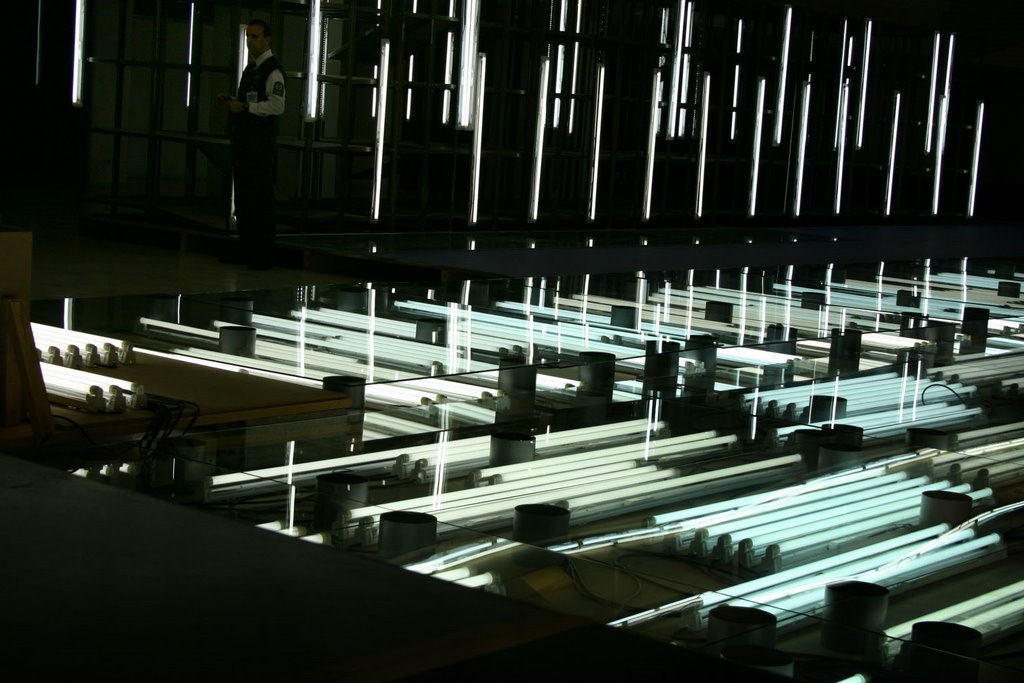
It is constructed. It is not freely distributed. It has a structure. It is the structure it has. The lights have rhythm. The lights are the chaotic order that sustains. They... some are covered with glass. Like a mirror of water. But their transparency doesn't support. Is it protected by those tables? Can we sit on the tables? And what about the guard? Does the guard know he is performing? I suppose so - both him and his colleague try hiding every time I take a picture. What is this light for? What lack of purpose? Who can I ask? Can I ask? Look at this red, look at this brown, look at this gray. Does it ring a bell? Does it ring? And once again: what are we shedding the light on? What foundation? What does it matter? After all, if it is THE FOUNDATION, shouldn't it matter? Those damned neon lights don't even shed the light, they produce it and let it go... Something apparently useless, apparently stumbling, ending, losing itself, or outdating itself? Then, as long as you persist, as there is another structure, and another, as there is a view, and a point of view, and a work, a body of work, you just find yourself within it, if you please.
And as a bonus, you get an engraving of an actor in a Japanese opera, from the wonderful exhibition of Japanese engravings, also at the Gulbenkian Foundation, only in the Library building.
It is constructed. It is not freely distributed. It has a structure. It is the structure it has. The lights have rhythm. The lights are the chaotic order that sustains. They... some are covered with glass. Like a mirror of water. But their transparency doesn't support. Is it protected by those tables? Can we sit on the tables? And what about the guard? Does the guard know he is performing? I suppose so - both him and his colleague try hiding every time I take a picture. What is this light for? What lack of purpose? Who can I ask? Can I ask? Look at this red, look at this brown, look at this gray. Does it ring a bell? Does it ring? And once again: what are we shedding the light on? What foundation? What does it matter? After all, if it is THE FOUNDATION, shouldn't it matter? Those damned neon lights don't even shed the light, they produce it and let it go... Something apparently useless, apparently stumbling, ending, losing itself, or outdating itself? Then, as long as you persist, as there is another structure, and another, as there is a view, and a point of view, and a work, a body of work, you just find yourself within it, if you please.
And as a bonus, you get an engraving of an actor in a Japanese opera, from the wonderful exhibition of Japanese engravings, also at the Gulbenkian Foundation, only in the Library building.


 Source URL: https://tattoosnyong.blogspot.com/search/label/Portugal

 )?
)?